The Requirement
A higher education client engaged RCRProjects to strengthen and modernise its approach to Planned Preventative Maintenance (PPM) across a complex estate. The scope covered statutory compliance, reactive maintenance and repair activities, all aligned to a long-term asset management strategy designed to improve control of risk, performance and cost across the estate.
With more than 250,000 assets across 16 London campuses, including buildings over 70 years old, the client faced significant challenges in maintaining compliance, prioritising maintenance activities, and supporting Net Zero objectives. As a result, a more strategic and data-driven approach was required.
This engagement followed a major estate-wide project delivered by RCRProjects, including a comprehensive M&E asset collection programme and statutory compliance review.
You can read more about our asset survey services here.
Review
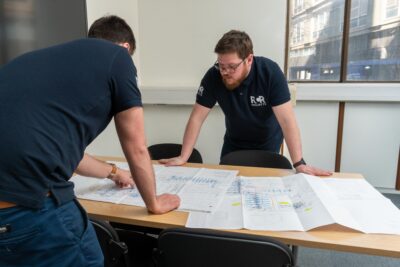
RCRProjects began with a detailed review of the client’s existing maintenance and compliance arrangements. This included auditing historic PPM delivery and statutory records across all campuses and assessing their existing compliance audit system for consistency and completeness. Furthermore we reviewed the client’s Net Zero strategy to align maintenance planning with sustainability and carbon reduction goals to enable us to map maintenance requirements across 250,000+ assets, ensuring full visibility of statutory tasks and resource allocation.
In response to the initial brief, RCRProjects developed a comprehensive programme of works to integrate with the client’s existing management processes. This involved a meticulous review of their compliance audit system, providing a full year’s tracking system for planned maintenance tasks across all assets. We also created a model to monitor task efficiency. RCRProjects scheduled regular maintenance tasks throughout the year and clarified the competency levels required for engineers to complete these tasks, using guidance from industry standards and other industry guidance.
Advise
Based on our findings, we provided a series of practical recommendations. In particular, these focused on compliance management, resource efficiency and sustainability objectives. As a result, the client gained a clearer framework for managing maintenance activities across the estate.
- Establishing a one-year compliance tracking system to improve visibility and control of statutory obligations.
- Introducing a performance model to monitor resource utilisation, cost and task efficiency.
- Defining competency requirements for maintenance activities using recognised industry standards and guidance.
- Integrating sustainability considerations into maintenance planning to support energy efficiency and Net Zero objectives.
Support
RCRProjects worked in partnership with the client’s estates team to implement the recommended improvements, providing scheduling of planned maintenance tasks across the academic year and ongoing technical oversight to ensure compliance levels remained high. We offered regular reviews to verify performance against statutory, and client-specific requirements, and continued advice on optimising resource efficiency and reducing unnecessary expenditure.
The Solution
By applying our Review > Advise > Support approach, RCRProjects helped the client establish greater control of compliance, maintenance performance and resource planning across a complex multi-campus estate.
As a result, the client is now consistently working towards statutory compliance levels of 95% or higher across all campuses. Furthermore, the framework continues to support informed decision-making and long-term estate planning.
In addition, the client now benefits from:
- Greater visibility and control over maintenance activities across the estate.
- Improved resource planning and cost management across 16 locations.
- Alignment between maintenance delivery, Net Zero commitments and wider sustainability objectives.
- Increased confidence that compliance, safety and asset performance are being effectively managed.
Consequently, the client is better positioned to support long-term value, manage risk and make informed investment decisions across its Built Environment.


